Thin-film technologies reduce the amount of active material in a cell. The active layer may be placed on a rigid substrate made from glass, plastic, or metal or the cell may be made with a flexible substrate like cloth. Thin-film solar cells tend to be cheaper than crystalline silicon cells and have a smaller ecological impact (determined from ). Their thin and flexible nature also.
[PDF Version]
Which solar panels use wafer based solar cells?
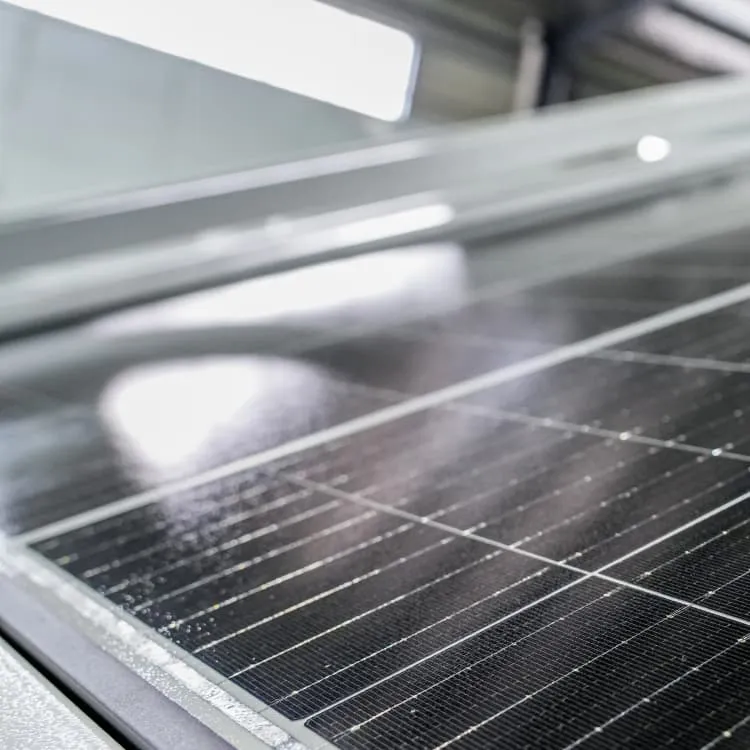
Both polycrystalline and monocrystalline solar panels use wafer-based silicon solar cells. The only alternatives to wafer-based solar cells that are commercially available are low-efficiency thin-film cells. Silicon wafer-based solar cells produce far more electricity from available sunlight than thin-film solar cells.
What are silicon wafer-based photovoltaic cells?
Silicon wafer-based photovoltaic cells are the essential building blocks of modern solar technology. EcoFlow’s rigid, flexible, and portable solar panels use the highest quality monocrystalline silicon solar cells, offering industry-leading efficiency for residential on-grid and off-grid applications.
Do silicon wafer-based solar cells produce more electricity than thin-film solar cells?
Silicon wafer-based solar cells produce far more electricity from available sunlight than thin-film solar cells. It’s helpful to note that efficiency has a specific meaning when applied to solar cells and panels. It’s a spec that measures the wattage produced per square meter (m²) of photovoltaic material exposed to peak sunlight.
Are there alternatives to wafer-based solar cells?
The only alternatives to wafer-based solar cells that are commercially available are low-efficiency thin-film cells. Silicon wafer-based solar cells produce far more electricity from available sunlight than thin-film solar cells. It’s helpful to note that efficiency has a specific meaning when applied to solar cells and panels.
Aluminium oxynitride (marketed under the name ALON by Surmet Corporation ) is a transparent ceramic composed of aluminium, oxygen and nitrogen. Aluminium oxynitride is optically transparent (≥80% for 2 mm thickness) in the near-ultraviolet, visible, and mid-wave-infrared regions of the electromagnetic spectrum. It is four times as hard as fused silica glass, the same hardness of 9. Chemical formula(AlN)ₓ·(Al₂O₃)₁₋ₓ, 0.30 ≤ x ≤ 0.37AppearanceWhite or transparent solidDensity3.691–3.696 /Melting point~2150 PropertiesAluminium oxynitride is resistant to various acids, bases, and water. Aluminium oxynitride has the following mechanical properties: • 2.68 GPa• 0.38–0.7. .
Aluminium oxynitride is used for infrared-optical windows, with greater than 80% transparency for 2 mm thickness at wavelengths below about 4 micrometers, dropping to near zero at about 6 micrometer. .
Aluminium oxynitride can be fabricated as windows, plates, domes, rods, tubes and other forms using conventional ceramic powder processing techniques. Its composition can vary slightly: the aluminium. .
Patents related to aluminium oxynitride include: • Aluminium oxynitride having improved optical characteristics and method of manufacture TM Hartnett, RL Gentilman
[PDF Version]
The reflective layer is designed to reflect the maximum amount of solar energy incident upon it, back through the glass substrate. The layer comprises a highly reflective thin metal film, usually either silver or aluminum, but occasionally other metals.OverviewA solar mirror contains a with a reflective layer for reflecting the , and in most cases an interference. .
The substrate is the mechanical layer which holds the mirror in shape. Glass may also be used as a protective layer to protect the other layers from abrasion and corrosion. Although glass is brittle, it is. .
The use of solar mirrors as a form of for has been proposed to address local temperature increases as well as to decrease . Proposition. .
The intensity of from at the surface of the is about 1 kilowatt per square metre (0.093 kW/sq ft), of area to the direction of the , under clear-sky conditions. When solar energ. .
(PV) which can convert solar radiation directly into are quite expensive per unit area. Some types of PV cell, e.g. , if cooled, are capable of converting efficiently up to 1,000 time.
[PDF Version]
In 2009, and developed the first on ultra‑thin glass substrate with a thickness of 30 (μm). In 2016, a glass battery was developed by , inventor of the and electrode materials used in the (Li-ion), and , an associate professor at the and a senior research fellow at
[PDF Version]
This article will introduce you the mainstream heat dissipation methods and thermal conductive interface materials of energy storage modules, including the classifications and how they work for the energy storage modules cooling..
This article will introduce you the mainstream heat dissipation methods and thermal conductive interface materials of energy storage modules, including the classifications and how they work for the energy storage modules cooling..
This article will introduce you the mainstream heat dissipation methods and thermal conductive interface materials of energy storage modules, including the classifications and how they work for the energy storage modules cooling. In the power grid system, the production and consumption of. .
Thermal energy storage in concentrating solar power plants. Thermal energy storage (TES) systems are essential components of concentrating solar power (CSP) plants that enable uniform generation of green electricity and process heat. The performance of sensible heat TES systems based on granular.
[PDF Version]
The Jambur Solar Power Station (JSPS), is an operational 23 MW (31,000 hp) in . The power station began commercial operations in March 2024. It is owned and was developed by the government of Gambia, with funding from the European Union, the European Investment Bank and the World Bank. The power generated here is integrated into the Gambian national electricity grid, through the National Water and Electricity Company network.
[PDF Version]